Oceanography

Relief of Oceans, Composition: Temperature, Density and Salinity, Circulation: Warm and Cold Currents, Waves, Tides, Sea Level Changes, Hazards: Tsunami and Cyclone

Ocean Relief

  • The Ocean Relief Features are quite different from the continental features because the Oceanic crust is less than 60-70- million years old whereas continental features are of Proterozoic age .
  • While there is only one global ocean, the vast body of water that covers 71 percent of the Earth is geographically divided into distinct named regions. The boundaries between these regions have evolved over time for a variety of historical, cultural, geographical, and scientific reasons.
  • Historically, there are four named oceans: the Atlantic, Pacific, Indian, and Arctic. However, a new ocean has now been recognized as the Southern (Antarctic) ocean as the fifth ocean. The Pacific, Atlantic, and Indian are known as the three major oceans.
  • They are the source of food– fish, mammals, reptiles, salt, and other marine foodstuffs.
  • The tides can be harnessed to provide power.
  • Oceanography is the branch of science that deals with the physical and biological properties and phenomena of the sea.
  • Earlier echo-sounding techniques were used, now radar soundings and electrical Echo devices are used to find the precise depths of ocean floors and map the relief of oceans.

Ocean Relief Features

  • The oceans, unlike the continents, merge so naturally into one another that it is hard to demarcate them.
  • The geographers have divided the oceanic part of the earth into five oceans, namely the Pacific, the Atlantic, the Indian, Southern, and the Arctic.
  • The various seas, bays, gulfs, and other inlets are parts of these four large oceans.
  • major portion of the ocean floor is found between 3-6 km below the sea level.
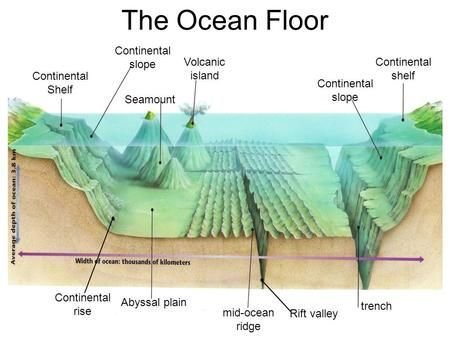
  • The floors of the oceans are rugged with the world’s largest mountain ranges, deepest trenches, and the largest plains. These features are formed, like those of the continents, by the factors of tectonic, volcanic, and depositional processes.

Major Ocean Relief Features

The ocean floors can be divided into four major divisions:

  • the Continental Shelf
  • the Continental Slope
  • the Deep Sea Plain
  • the Oceanic Deeps

MOCK TEST

0%
0 votes, 0 avg
29
Created by Nabarun Academy
Best Geography Coaching Centre in Kolkata

OCEANOGRAPHY MOCK TEST SET _1

1 / 13

1. Who is called Father of Oceanography?

2 / 13

2. Which country headed the Challenger Expedition (1872-76)

3 / 13

3. Kiel Canal Connects

4 / 13

4. The Sargasso Sea (Weed Growing Sea) lies in the

5 / 13

5. because of the The Oceanic ridge come into existence

6 / 13

6. The precious minerals like Petroleum and Natural Gas are found in

7 / 13

7. Which one of the following is correct arrangement of oceans in ascending order as of their size

8 / 13

8. The Average temperature of the surface water of the ocean is

9 / 13

9. The Diego Garcia is an island located in in which of the following oceans

10 / 13

10. The line joining the points of Equal depth are known as

11 / 13

11. The ocean water was iceberg free during the era

12 / 13

12. Surface Circulation of Ocean water is due to

13 / 13

13. Flat topped volcanic hills submerged under ocean water are called

Your score is

The average score is 34%

0%

0%
0 votes, 0 avg
15
Created by Nabarun Academy
Best Geography Coaching Centre in Kolkata

OCEANOGRAPHY MOCK TEST SET _2

1 / 14

1. The Turbidity Current Theory is responsible for

2 / 14

2. Archipelago refers to

3 / 14

3. The average density of sea water is

4 / 14

4. Most of the salt in the sea water is derived from

5 / 14

5. The cold current flowing along the coast of Chile and Peru is known as

6 / 14

6. The most important source of iodine and potash in ocean water is

7 / 14

7. The average difference in the water level between high tide and low tide at a place is referred to as

8 / 14

8. The Bosphorus Strait is located between

9 / 14

9. The maximum oceanic salinity is found in

10 / 14

10. The average salinity of ocean water is

11 / 14

11. What is the most common salt in the sea water?

12 / 14

12. The busiest oceanic Route is

13 / 14

13. Which one of the following has the highest salinity level?

14 / 14

14. The Great Barrier Reef is located

Your score is

The average score is 38%

0%

0%
0 votes, 0 avg
11
Created by Nabarun Academy
Best Geography Coaching Centre in Kolkata

OCEANOGRAPHY MOCK TEST SET _3

1 / 12

1. The Bermuda Triangle or Devil's Triangle lies on

2 / 12

2. Diatom ooze is very frequently found at greater depth in

3 / 12

3. The difference between high tide water and low tide water is called

4 / 12

4. What is Diatoms?

5 / 12

5. A Nautical mile is equal to

6 / 12

6. The largest tide occurs in the world in

7 / 12

7. In which year Titanic ship sunk in North Atlantic Ocean

8 / 12

8. Which of the following seas has the highest salinity

9 / 12

9. The Echo sounder instrument measures the

10 / 12

10. The highest tide occurs in India is near

11 / 12

11. The S-shape bottom reliefs are found in

12 / 12

12. The major cause of Titanic ship sinking in North Atlantic Ocean was

Your score is

The average score is 57%

0%

0%
0 votes, 0 avg
9
Created by Nabarun Academy
Best Geography Coaching Centre in Kolkata

OCEANOGRAPHY MOCK TEST SET _4

1 / 14

1. What is the ideal temperature required for survival of coral reefs

2 / 14

2. The first marine sanctuary in India, having its bounds coral reefs, mollusca, dolphins, tortoise and various kinds of sea birds, has been established in

3 / 14

3. Which one of the following sea is without a coast line?

4 / 14

4. Salinity in water bodies increase with

5 / 14

5. The general depth of Abyssal Plains varies between

6 / 14

6. Coral reefs are normally found between

7 / 14

7. Seiche is a type of

8 / 14

8. The density of sea water depends upon

9 / 14

9. The wave-cut platform is found in

10 / 14

10. The Guam is an Island in Micronesia which lies on

11 / 14

11. A Shallow stretch of seawater partly on completely separated from the open ocean by a reef is called

12 / 14

12. Spring and Neap Tides

13 / 14

13. Diamond Harbour and Salt Lake City are situated in

14 / 14

14. The Socotra Island is situated in

Your score is

The average score is 44%

0%

0%
0 votes, 0 avg
11
Created by Nabarun Academy
Best Geography Coaching Centre in Kolkata

OCEANOGRAPHY MOCK TEST SET _5

1 / 14

1. What is La Nina

2 / 14

2. Which of the following area is called Cape of Good Hope

3 / 14

3. Who Propounded Subsidence Theory of formation of coral reefs

4 / 14

4. In Grand Bank and George Bank abundant productive fishing ground are found due to

5 / 14

5. Which one of the following countries has the world's longest coastline

6 / 14

6. A cold ocean current flows from south to north along the western coast of South Africa is called

7 / 14

7. Who propounded the theory of stand still theory of formation for coral reefs?

8 / 14

8. The Glacial Control Theory of formation of coral reefs was propounded by

9 / 14

9. The famous productive fishing ground Dogger bank are lies in

10 / 14

10. What is the real time taken by the tide?

11 / 14

11. Which features are called rainforest of oceans?

12 / 14

12. Which of the following is the islands of corals

13 / 14

13. Kiel Canal Connects

14 / 14

14. What is the most important effects of oceanic currents?

Your score is

The average score is 44%

0%

Welcome

More information